Broker
AI misinformation: a reason to reconnect
Errors, misinformation and hallucinations were the top AI concern in Gallagher’s survey. Help insureds assess their exposure.
READINESS FOR AI VISIBILITY
An offer you can take across your book
Bring the summary to an insured between renewals to reinforce your role as a trusted adviser. With a former contact, share the example report and offer to arrange an assessment of their business.
AAAnow assesses what AI can find and interpret on the insured’s website and in its PDFs. The summary highlights gaps that could lead to misinformation.
Connect with Me

Broker request
Request a call or an assessment
Example AI Readiness Summary
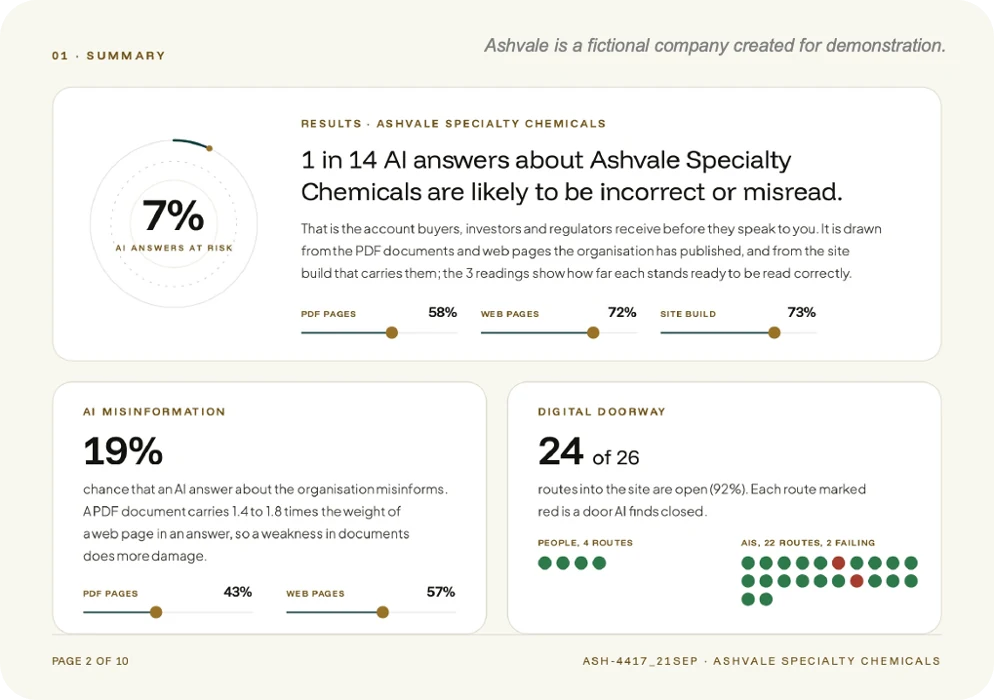
This fictional example shows 7% of AI answers at risk, or 1 in 14 answers likely to be incorrect or misread. Readiness indicators show PDF pages at 58%, web pages at 72% and site build at 73%. The AI misinformation panel shows a 19% chance of an answer misinforming, with PDF pages at 43% and web pages at 57%. Digital Doorway shows 24 of 26 access routes open, or 92%: all 4 people routes and 20 of 22 AI routes, with 2 AI routes failing.
The sample report is illustrative and subject to change.
- 01
Digital Doorway
Can AI find and access the insured’s website?
The report shows which tested access routes are open, restricted or closed.
- 02
Readiness summary
Can AI interpret the insured’s pages and documents?
The summary covers how AI reads web pages and PDFs published by the insured.
- 03
Asset summary
Where could AI give a misleading account of the insured?
The insured can see where its own web pages or PDFs could contribute to a misleading answer.
Gallagher · February 2026
Why raise misinformation with an insured?
AI errors, misinformation and hallucinations were the leading perceived threat from AI adoption in Gallagher’s 2026 survey, cited by 57% of respondents.
Read the Gallagher survey (opens in a new tab)
For insurance brokers
Ten questions about AI Readiness for insurance brokers
Why raise AI misinformation with an insured that does not use AI?
People can use AI to ask about a business whether or not the insured uses it. The assessment looks at what external AI can reach and where the insured’s own published information could contribute to a misleading answer.
Gallagher’s 2026 survey identifies AI errors, misinformation and hallucinations as the leading perceived threat from AI adoption. Read the Gallagher survey (opens in a new tab)
How can the summary inform a discussion about insurance cover?
The summary describes the insured’s exposure to likely misinformation. It does not establish liability for the company or its directors and officers, or determine cover.
If the insured commissions corrective work and monitoring, it can document that work as evidence of mitigation. Aon discusses the importance of governance and documentation to underwriters. Read Aon’s AI risk guidance (opens in a new tab)
How can we request an AI Readiness assessment for an insured?
Use the assessment form and enter your name, your email and the insured organisation’s name. You can indicate whether the concern is company exposure, directors’ and officers’ liability, or both.
What does the summary add to an insured’s risk assessment?
You can include the insured’s starting position on readiness for AI visibility and likely misinformation when discussing their exposure. The summary covers what AI can access and interpret on the insured’s website and in its PDFs.
What can we include in the insurance renewal?
You can include an AI Readiness Summary showing the insured’s level of exposure to likely misinformation.
Could carrier funding pay for an insured’s AI Readiness audit?
Yes. Carrier marketing or support funding can pay for a detailed AI Readiness audit for an insured.
How does this fit alongside a cyber assessment?
As with a cyber assessment, you can offer the insured a way to establish where they stand. Here the focus is on the organisation’s published information and whether AI can find and interpret it correctly.
Can AAAnow help us brief a group of insureds?
Yes, AAAnow can work with you on events, webinars and sector briefings for your insureds. You can introduce the risk to the group and offer an individual assessment to insureds who want to understand their own exposure.
What can I share with an insured before requesting a report?
The example report uses a fictional company to show how the summary presents an organisation’s exposure to misinformation. View the example report (opens in a new tab).
What if the insured wants to monitor its exposure?
AAAnow can reassess the insured’s exposure after changes or provide ongoing monitoring and independent reporting through AI Confidence.
Visit our website
AAAnow’s website explains how organisations can assess their readiness for AI visibility and monitor their exposure to likely misinformation.
Visit AAAnow.ai (opens in a new tab)